
Mathtris
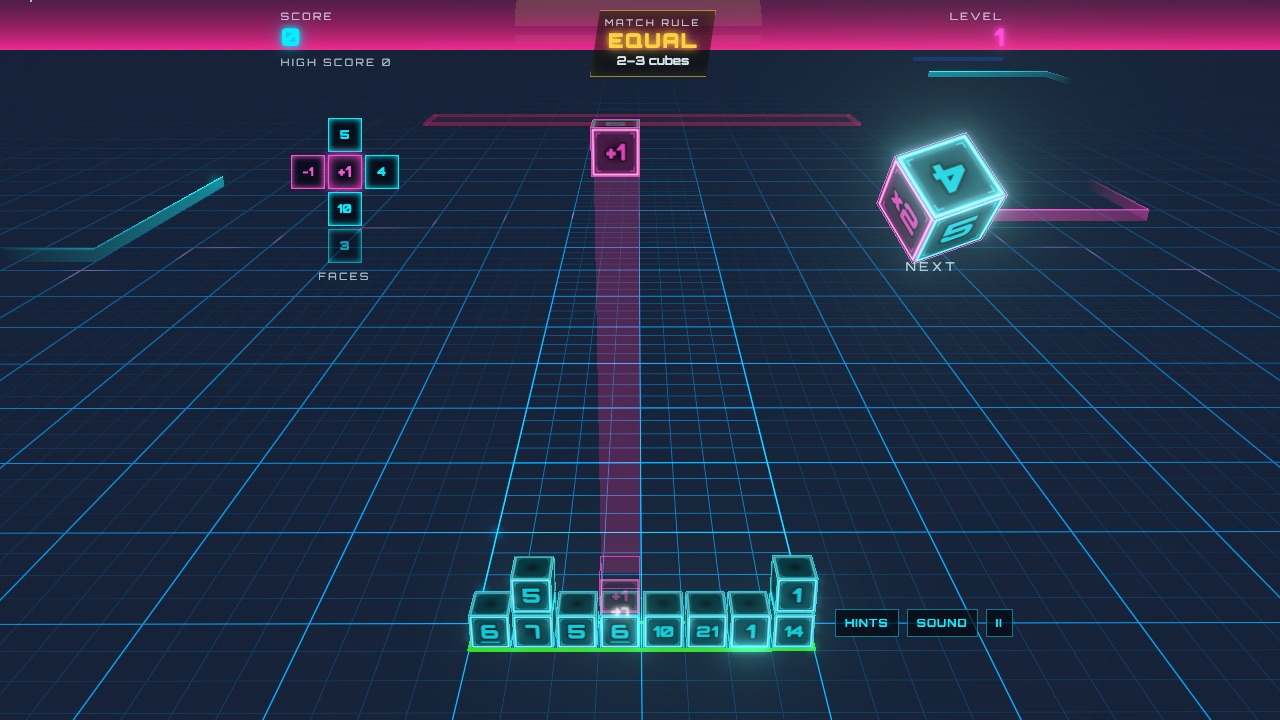
A free game of maths and falling cubes, in a neon world. Every cube has a number or a maths operator on each of its six faces. Turn it so the face you want points at you before it lands, and connect numbers that fit the rule.
- Free
- 1 player
- Computer, tablet and phone
- 4 difficulty levels
- Danish and English
How to play
Cubes fall one at a time. Before a cube lands, you move it and turn it, because only the face pointing at you counts when it lands.
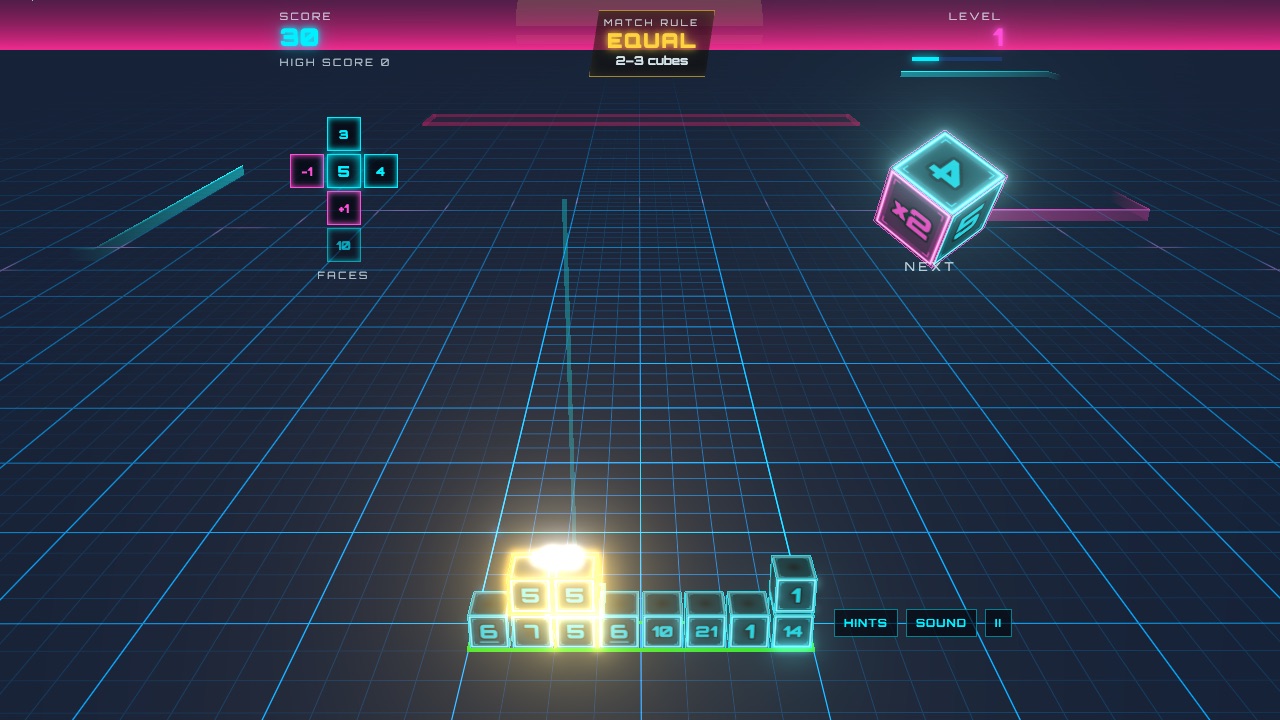
- Connect numbers that fit the rule. Each level has a match rule, shown at the top of the screen: for example two or three cubes with the same number, or cubes that add up to 10. When a group of connected cubes fits the rule, it clears. The group must include the cube that just landed.
- Operators change numbers. A face like +1, ×2 or x² changes every number it lands next to, and then disappears. With no number next to it, it turns into junk.
- Chain reactions. When cubes clear, the ones above fall down and can make new groups. Combos score more.
- Pieces. From level 2, a shape of two or three cubes sometimes falls. It breaks apart when it lands.
Each level is a little faster than the last and brings a new rule. The first time you play, short prompts show you the moves as you need them.
The rules, level by level
| Level | Rule | What clears |
|---|---|---|
| 1 | EQUAL | 2–3 connected cubes with the same number. The numbers are 1 to 6. |
| 2 | SUM | 2–3 connected cubes that add up to the target, a number from 8 to 12. The numbers now go up to 9. |
| 3 | PLUS & MINUS | A number next to the same number with the other sign, like 4 and −4. Negative numbers arrive. |
| 4 | SUM | Exactly 3 cubes that add up to a small target, from −3 to 3. |
| 5 | DOUBLE | A number next to its double or its half, like 3 and 6. |
| 6 | SUM | Exactly 3 cubes that add up to 19–24. No two numbers are enough. |
| 7 and up | All of them | The rules take turns, and TRIPLE joins them: a number next to three times it, like 2 and 6. Sums can need up to 5 cubes, and the cubes fall faster every level. |
The operators
| Face | What it does to the numbers next to it |
|---|---|
| +1, −1, +2, −2, +5, −5 | Adds or subtracts. |
| ×2, ×3 | Doubles or triples. |
| ÷2 | Halves, dropping any remainder. |
| ± | Flips the sign: 4 becomes −4. |
| x² | Squares the number. |
Operators can rescue a number that fits nowhere: a +1 landed next to a 4 turns it into a 5. Choose where it lands with care, because it changes every number it touches.
Controls
| Action | Keyboard | Touch |
|---|---|---|
| Move | ← → | ◀ ▶, or drag |
| Spin the cube left or right | A D | SPIN, or tap |
| Tilt the cube up or down | W S | TILT |
| Rotate a piece of several cubes | R | ROTATE |
| Fall faster / drop | ↓ / Space | ▼, or swipe down |
| Pause (and end the game) | Esc / P | II |
Difficulty and hints
Pick a difficulty on the start screen: EASY, MEDIUM, HARD or EXTREME. The rules and the speed are the same in all four. What changes is how much the cubes help you: on the easier levels, a falling cube often carries a face that completes a group already on the board, so the skill is finding it by turning the cube. On EXTREME, the cubes give no help at all.
Hints are on from the start. A wireframe ghost shows where the cube will land, cubes that would clear glow gold, and the numbers an operator would change show the value they'd become. Turn hints off with H or the HINTS button once you don't need them.
For parents and teachers
Mathtris is mental arithmetic in a game. Each level practises something specific:
- Number pairs and sums: finding two or three numbers that make 8 to 12 (level 2), and later three numbers that make 19 to 24 (level 6).
- Negative numbers: opposites like 4 and −4 (level 3), and sums with a target near zero (level 4).
- Doubling, halving and tripling (level 5, and TRIPLE later on).
- The effect of an operation: what +2, ×2, ÷2, ± or x² does to a number, worked out before the cube lands.
- Spatial thinking: turning a cube in your head to find the face you need.
The difficulty levels change how much help the game gives, not the maths, so EASY is a good place for a younger player to start, and the pause button stops the clock any time. Mathtris has no accounts and no chat, and it may show a single ad between two games, never during one and never personalised. Mathtris's privacy page lists what the game keeps on the device.
Questions and answers
- Is Mathtris free?
- Yes. There's nothing to buy.
- Do I need to download anything?
- No. Mathtris runs in any modern browser, on a computer, tablet or phone.
- Which language is it in?
- English or Danish. It follows your browser's language, and EN / DA on the start screen switches it.
- What happens when a cube can't clear anything?
- It stays where it lands. An operator with no number next to it turns into junk, which only breaks when a group next to it clears. When the cubes stack up to the top, the game is over.
Latest updates
- 11 October 2026: Mathtris is out, in English and Danish, with four difficulty levels, a first-run tutorial and pieces of two or three cubes.
Everything new is in the news. More about the game itself: Mathtris's own About page.